Save These 21 Wedding Ideas For Your Big Day
Wedding ideas that actually photograph well, broken down by the few decisions that cascade into everything else (palette, venue, lighting, florals).
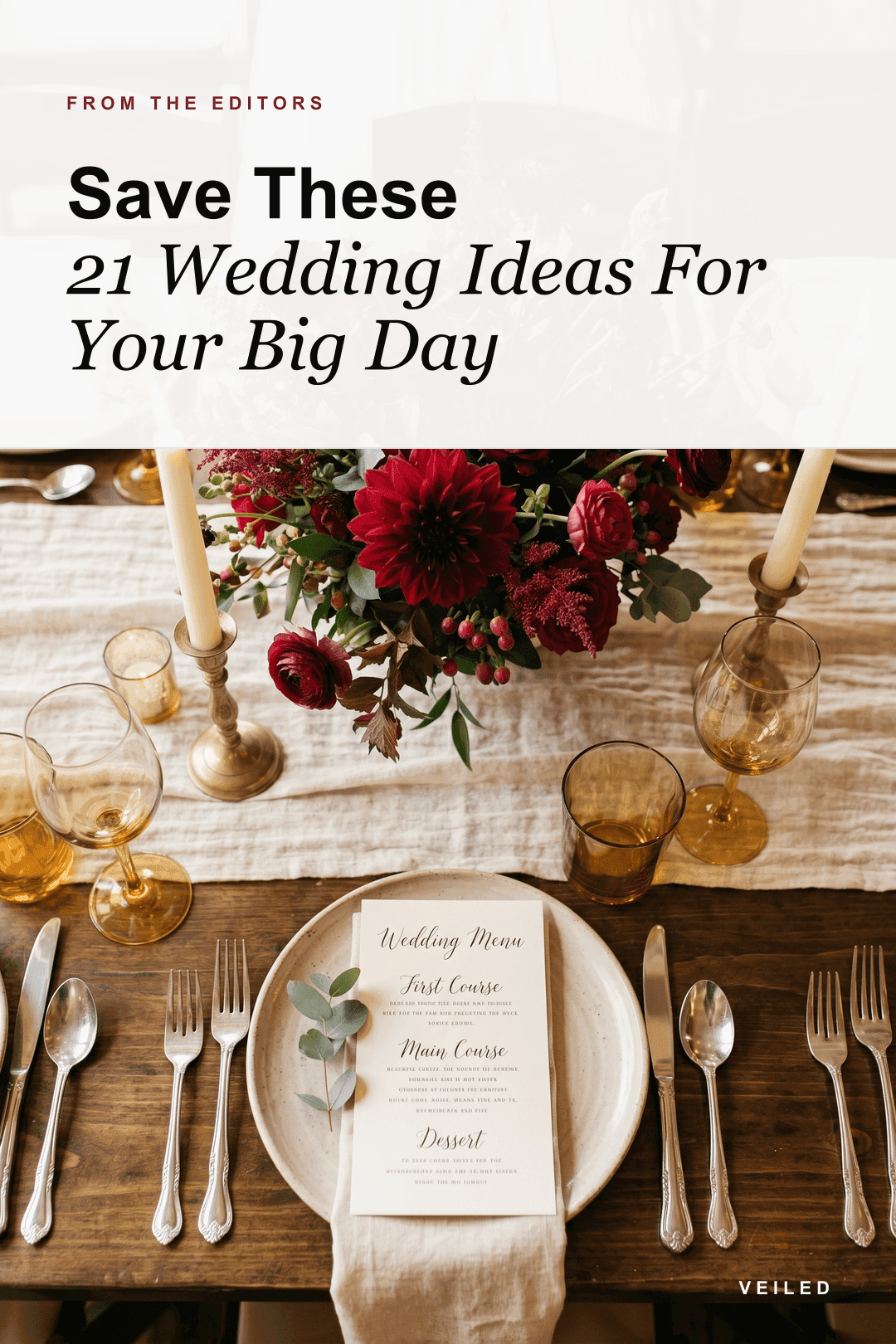
Most lists of wedding ideas are dumps. Two hundred Pinterest pins ranked by what saved well last year, with no pattern underneath. The version that helps is shorter and more opinionated: there are roughly six decisions in any wedding that cascade into 80 percent of the rest, and once you make those well, everything else is paint. Here's how the most-saved 2026 weddings handle each of the six, and the wedding ideas worth stealing from them.
Why most wedding-ideas lists fail you
The standard wedding-ideas roundup tries to be comprehensive. Two hundred pins, every aesthetic, every season, no point of view. Couples leave the list with twenty saved photos that don't agree with each other and a moodboard that quietly contradicts itself.
The 2026 weddings that actually photograph well are the opposite. They commit early to one anchor decision, let that decision narrow every subsequent one, and the result is a coherent visual identity that reads as deliberate rather than thematic. Pinterest's most-saved boards from the last 18 months consistently follow this pattern.
The six decisions that cascade
If you make these six well, the wedding makes itself. If you skip any one, you'll spend the planning year fighting friction in unrelated categories. Each decision below has a three-to-five-month lead time, so working backward from a 12-month engagement, you should have all six locked by month nine.
- Color story: pick a single anchor color and two supports. Three is the maximum that photographs as intentional
- Venue: this constrains roughly 80 percent of every subsequent choice (florals, lighting, capacity, catering style, music)
- Florals: one statement installation versus fifteen small arrangements. Pick the strategy first, then the flowers
- Lighting: most-overlooked, most-impactful. Candlelight density is the single largest visible difference between strong and weak reception photos
- Music timing: ceremony music, cocktail format, reception arc. The structure decides energy more than song selection does
- Photography style: documentary versus pose-direction. Tells you which photographer to book, not which one is best
"Six decisions cascade into 80 percent of the rest. Make those well and everything else is paint."
Color story: one anchor, two supports
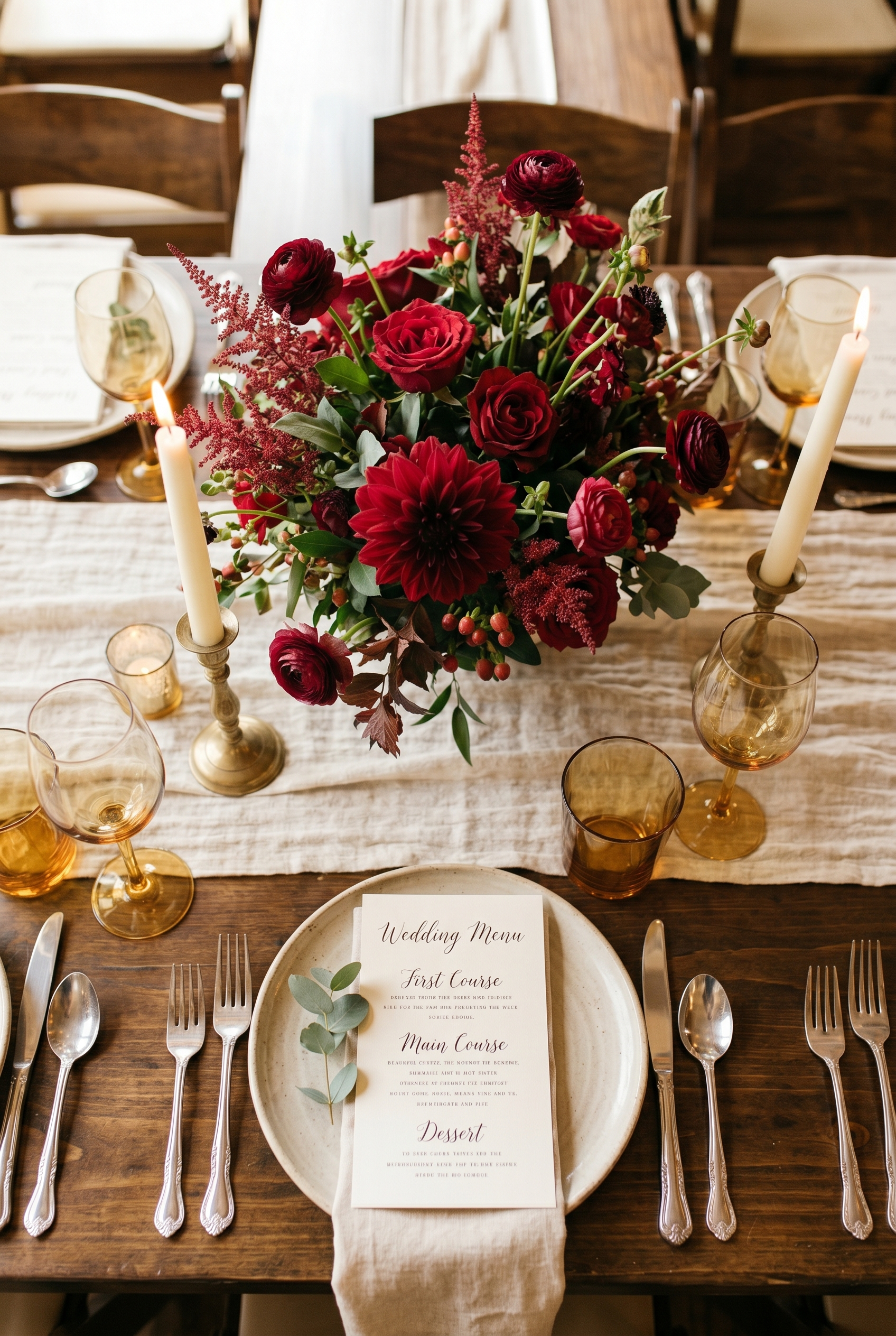
Cherry red, deep cream, and antique silver. Sage, bone, and brushed brass. Deep navy, blush, and copper. The pattern is always one saturated anchor plus two structural neutrals. Couples who try to run four or five active colors end up with what florists privately call beige soup, where every element competes for attention and the eye has nowhere to land.
The single most-saved 2026 palette across our editorial review is cherry-on-cream, with about 31 percent of palette inquiries citing some version of it. Sage palettes, which dominated 2021 through 2024, have started cooling, especially when paired with cream-only accents. The shift toward warmer cherry and burgundy palettes tracks with Pantone's broader 2026 color direction.
Whatever you anchor with, write the three colors down before you book your florist. Send the same three to your stationer, your linen rental, and your dress consultant. The wedding industry's biggest cost driver is not booking the wrong vendor, it's vendors making different assumptions about your palette and producing work that doesn't agree.
Venue choice is 80 percent of every other choice
A barn cascades you into specific florals (deep, dramatic, scaled to the architecture), specific lighting (bistro lights and candle clusters because the architecture absorbs light fast), specific catering (family-style or grazing tables, rarely plated), and a specific music format (band over DJ for the room's acoustics). A ballroom forces the opposite of every one of those choices.
The mistake we keep seeing: couples pick the venue last, after they've already committed mentally to florals or attire that don't fit. The cleanest planning order is venue first, then color story, then everything else. If you skip this order you'll spend the engagement year retrofitting choices that should have come from the venue itself.
Read our cluster on barn weddings, beach weddings, and courthouse elopements for venue-specific cascades. Each one goes deep on what works in that context and what to skip.
Florals: one statement, not fifteen mason jars
The most photographically high-impact floral move at any budget is concentration. One six-foot installation behind the head table photographs as more luxurious than fifteen modest centerpieces at the same total cost. The math is the same; the photos are not.
If your floral budget is under $4,000, spend nothing on aisle florals or bridesmaid bouquets and put the entire amount into one focal piece. The bouquet you carry can be three deep cherry dahlias and ranunculus from a Trader Joe's hand-tie. Photographers will frame around the focal installation, and that's the shot that ends up on your album cover.
Lighting is where weddings live or die
Receptions that photograph as warm and intimate are receptions with 200 to 400 visible candles across the space. Receptions that photograph as a fluorescent meeting room have under 100. Most couples under-budget for candlelight by an order of magnitude, then can't figure out why the photos feel flat.
Real beeswax candles over paraffin (they smell better, burn warmer in the photos), taper candles over pillar (taller flame profile), and clusters of three to seven on every horizontal surface. If you do nothing else right with lighting, get the candle count right. The single largest budget-to-impact ratio in wedding photography lives here.
Music timing as a structural choice
Most receptions front-load the high-energy music for the first dance and toasts, then stall around hour two when the energy was supposed to peak. The pattern that works: open with cocktail-friendly mid-tempo (about 60 minutes), build through the early reception (75-100 BPM range during dinner), then peak after speeches when guests have warmed up. The strongest wedding DJs and bands plan the arc explicitly.
If you book a band, ask for their last three setlists rather than their demo reel. The setlist tells you whether they understand the arc; the demo reel tells you what they want to play.
What we'd skip
Wedding programs nobody reads, favors that get left on tables, signature cocktails that fight your color story, sparkler exits that smoke up the photos, and chair sashes (any chair sash, ever). These are the categories that get added because the wedding industry sells them, not because couples want them.
Take that money and put it into either photography or one of the six anchor decisions above. The average chair sash budget at a 120-guest wedding is $480. The same money funds a meaningfully better lighting designer or a second photographer for golden hour.
FAQ
Frequently asked
How early should we start brainstorming wedding ideas?
Twelve to fifteen months out is the sweet spot. Earlier than that and you'll change your mind a dozen times before booking; later than that and the best venues and photographers are gone. Start with the six anchor decisions, leave the rest until you've signed your venue contract.
How do we decide between a venue we love and a venue our parents want?
Pick the venue that makes the photos look the way you want. Family politics around venue selection are real but never improve once the wedding is booked, and you'll see the venue every time you look at your album for the next forty years. Compromise on guest list size, food choices, or seating, not on the venue itself.
Are the wedding ideas in this list realistic for a sub-$25K budget?
Every decision in this article scales down. The single floral statement works at $1,500 just as well as at $8,000, the candlelight density works at any guest count, and the music timing arc costs nothing. The six anchor decisions are about commitment and order, not budget. A confident $20K wedding photographs better than an indecisive $80K one.