Save These 27 Wedding Centerpiece Ideas For 2026
Wedding centerpiece ideas that read as designed, not Pinterest-cluttered. Florals, candles, sculptural objects — the 2026 shift toward fewer, better pieces.
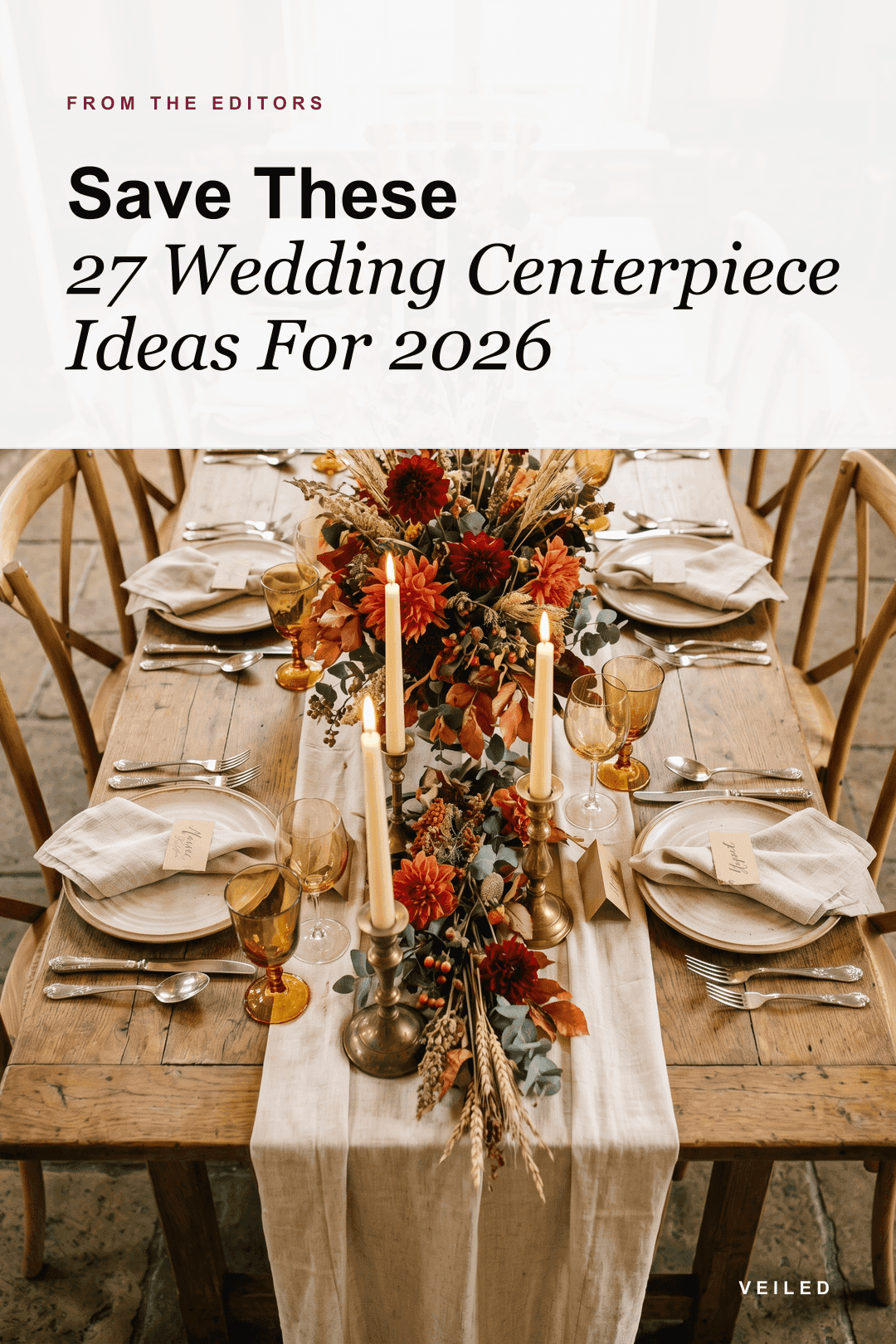
Wedding centerpiece ideas have undergone a quiet shift since 2022. The dominant pattern used to be quantity (one centerpiece per table, plus a head-table arrangement, plus aisle pieces, plus cocktail-hour accents). The 2026 version goes the other way: fewer, larger, more confident pieces. One installation can carry an entire reception when the rest of the room gets out of its way. Here are the centerpiece ideas saving most consistently on Pinterest's most-saved 2026 boards.
The 2026 centerpiece shift
What's faded: the fifteen mason jars per table arrangement, the obligatory votive cluster surrounding every centerpiece, the cylinder-vase-with-submerged-orchid look that defined 2017 through 2020. What's replaced them: low sculptural florals that don't block sightlines, candle-led centerpieces with dramatic taper density, and entire-runner installations that span the spine of long farm tables.
The shift maps to the broader editorial trend in 2026 weddings: restraint reads as luxury. A confident centerpiece commits to one approach and lets the rest of the table breathe. The maximalist version with eight components fighting for attention rarely photographs as well, no matter how much was spent on the components.
The five centerpiece styles dominating 2026
These are the five wedding centerpiece ideas appearing most consistently on Pinterest's most-saved 2026 wedding boards. Each works at different budget tiers; the cost difference is mostly in the floral component, not the structural one.
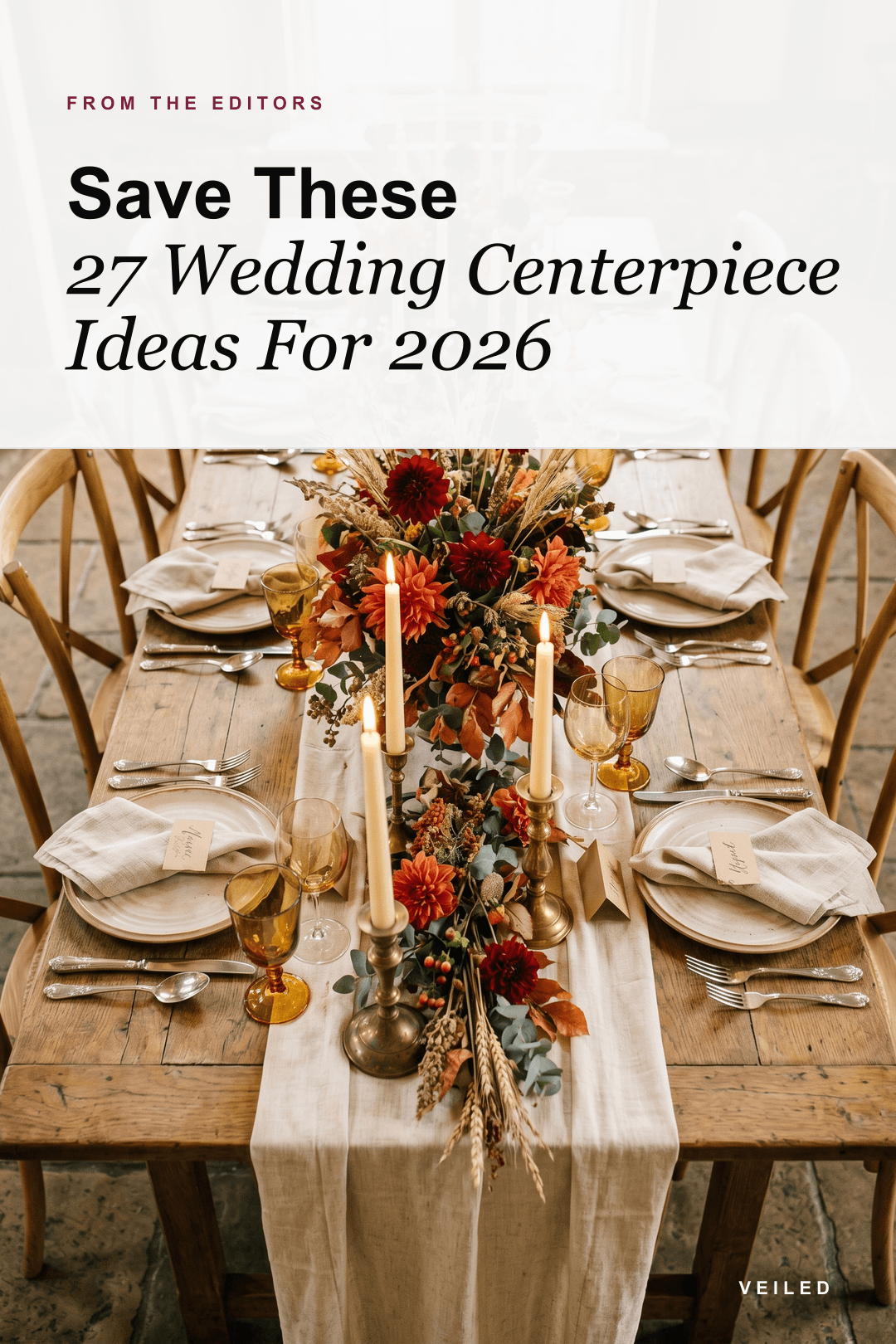
- Sculptural floral runner — entire-table installation, low and dramatic, photographs as one continuous piece
- Single-bloom statement — one oversized vessel with three to five large blooms, sculptural rather than abundant
- Candle-led density — twelve to twenty taper candles per six-foot table, minimal florals
- Foraged greenery + dried elements — olive branch, eucalyptus, dried wheat, smoke bush, no fresh blooms at all
- Edible centerpiece — composed produce platter (heritage tomatoes, citrus, fresh herbs) doubling as guest grazing
"Restraint reads as luxury. A confident centerpiece commits to one approach and lets the rest of the table breathe."
Sculptural floral runner
The most-saved 2026 centerpiece pattern by a wide margin. A continuous floral installation runs the spine of a long farm table from end to end, low-profile (8-12 inches tall) so guests can see across, with dramatic blooms (cherry dahlias, garden roses, ranunculus) anchored in foam-free mechanics that the florist places on the morning of the wedding.
Cost-wise this is more expensive than per-table arrangements at the same total flower count, because labor goes up significantly. A 20-foot runner takes a florist roughly 45-60 minutes to install on-site versus 10-15 minutes per centerpiece. Plan for the labor surcharge. The visual payoff is worth it for the head-table or sweetheart-table installation; for guest tables it's less essential.
Single-bloom statement
One sculptural vessel (a low ceramic dish, a hammered brass bowl, a vintage compote) with three to five large blooms placed asymmetrically. Cherry dahlias plus a single trailing element (eucalyptus, olive branch, smoke bush). The total flower count is small but the photographic impact is high.
This works especially well for round 60-inch guest tables where a runner-style installation doesn't fit the geometry. Cost per centerpiece in 2026 runs roughly $60-$140 depending on bloom selection and vessel rental, which is comparable to or cheaper than the multi-component centerpieces of 2018-2022.
Candle-led density
Twelve to twenty taper candles per six-foot table section, in brass or antique silver holders, with minimal florals or none at all. The candle density is what carries the photograph, especially at evening receptions. The pattern works at any budget tier because candles cost very little compared to the visual impact they produce.
The math that matters: a 100-guest wedding with 10 round tables and candle density at this level uses roughly 150-200 tapers across the room. At about $1.50 per taper bulk-bought, that's $225-$300 in candles for the entire reception. The same money in fresh florals barely covers two centerpieces.
Foraged greenery + dried elements
All-greenery centerpieces fell out of favor briefly in 2022-2023 (eucalyptus fatigue) and came back in 2025-2026 with more variety. Olive branch, smoke bush, dried wheat, dried strawflower, copper foliage, italian ruscus. The pattern leans seasonal: dried elements for fall and winter, fresh foraged greens for spring and summer.
The cost advantage is real. A foraged-greenery centerpiece runs about half the cost of a fresh floral one because the materials are cheaper and the design holds up longer (dried elements don't wilt). For couples with under-$3,000 floral budgets, this category produces the highest ratio of photogenic-result to dollars-spent.
Edible centerpieces (rising)
Composed produce platters as centerpieces are growing on Pinterest in 2025-2026. Heritage tomatoes in mid-summer, stone fruit and basil in late summer, citrus and pomegranate in winter. The platter doubles as guest grazing through the cocktail hour, then gets cleared before dinner service.
The trick to making this look intentional rather than chaotic: monochromatic-ish color story (all reds and oranges, or all greens and yellows) and one structural element (a wooden board, a marble slab) underneath. Skip the cheese-and-meat charcuterie format on the dinner table itself; that reads as cocktail hour rather than centerpiece.
Mismatched eclectic / curated styling
The opposite move: instead of one statement piece, a deliberately curated mix of small vessels (vintage brass candlesticks, ceramic vases, mercury glass votives) in coordinated color tones across the table. The look reads as collected over time rather than rented for the day. Works especially well at home weddings and venues with character.
What separates this from cluttered: every object earns its place. Three sizes of vessels, three heights, one tonal family, no symmetry. Symmetric eclectic reads as scattered; asymmetric eclectic reads as designed. The execution is harder than a single statement piece but the result feels handmade rather than rental-catalog.
FAQ
Frequently asked
How much should we budget for centerpieces in 2026?
For 10 guest tables at a 100-guest wedding: $600-$1,500 for foraged-greenery or candle-led options, $1,200-$3,000 for single-bloom statements, $2,500-$6,000+ for sculptural floral runners across all tables. Picking ONE elaborate runner for the head table and simpler arrangements for guest tables is the cost-effective compromise we recommend most often.
What's the most overrated centerpiece trend right now?
Tall vase with submerged orchids, hands down. Aged badly, photographs flat, blocks sightlines, expensive per arrangement. Couples who book this style in 2026 almost always wish they'd done a low statement instead. The candle-led density pattern produces better photos for a fraction of the cost.
Can wedding centerpieces double as guest favors?
Sometimes. Single-stem centerpiece blooms (a peony, a single garden rose) can be sent home with one designated guest per table, but only if you've planned the logistics in advance. Florists need to know which arrangements are 'going home' so they can mechanic them differently. Don't decide this on the wedding day; the floral structure has to support the takeaway.