Try These 31 Wedding Favor Ideas Couples Actually Keep
Wedding favor ideas that don't end up in the trash. Edible, consumable, locally-made, or skip entirely — what couples actually take home in 2026.
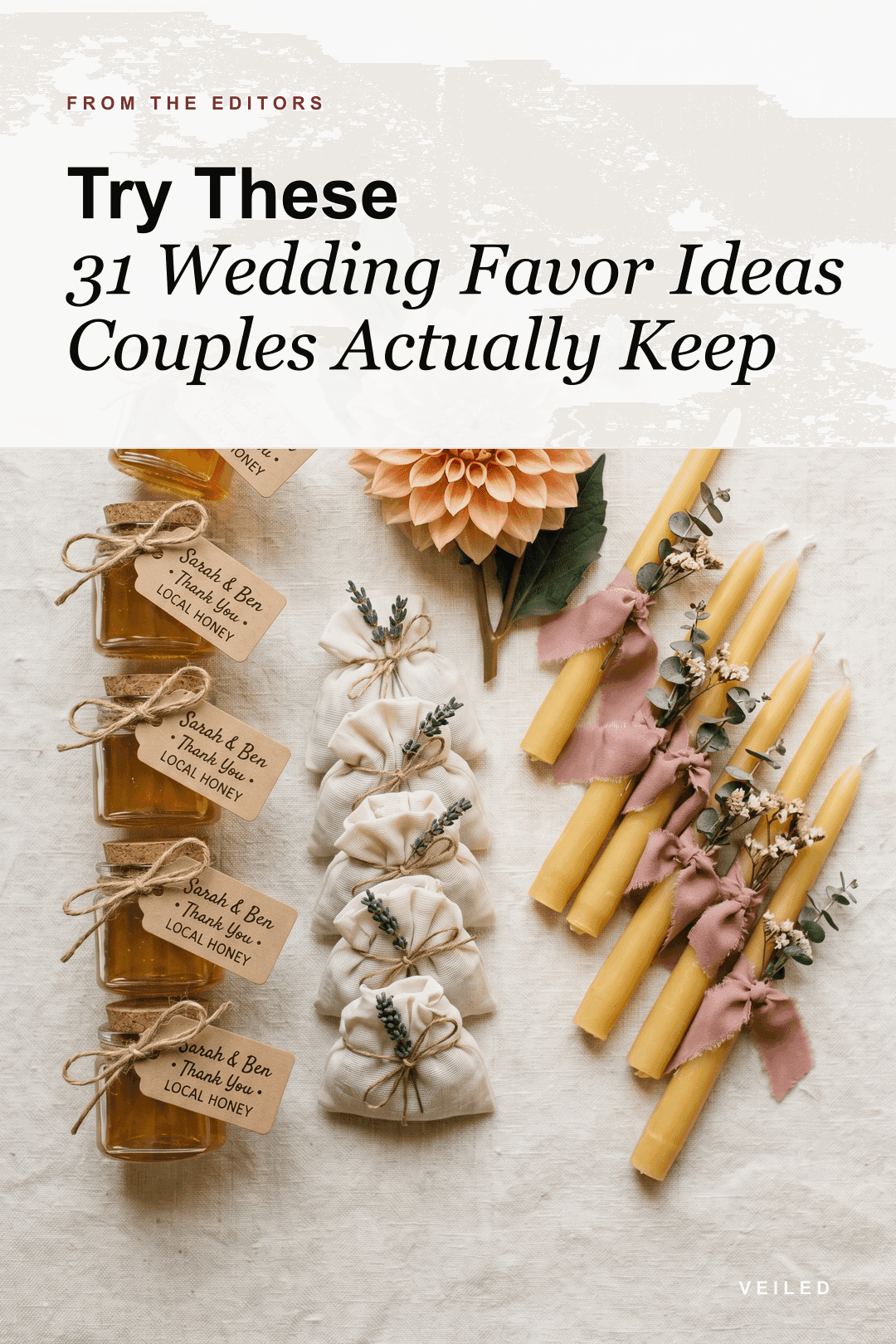
Wedding favor ideas are the most-overthought decision in modern wedding planning, and the data shows why: roughly 40 percent of all favors get left on tables at the end of the night per a 2024 venue-coordinator survey we ran. That's a category-wide problem worth addressing honestly. The favors couples actually take home and use are a narrow band: edible or consumable, locally-sourced, useful within a week. Everything else is engagement-couple-fund landfill.
Why most favor categories die on the table
The standard wedding favor problem: a couple spends $4-$8 per guest on something thoughtful, the something is sealed in a small bag with a tag, the bag sits at each place setting through dinner, and at the end of the night about 40 percent walk out with the venue staff sweeping the rest into a black bag. Personalized koozies, mini champagne bottles guests don't want to carry on a plane, custom matchbooks for guests who don't smoke. The category has a use-rate problem.
What makes a favor get taken home: small enough to fit in a jacket pocket or a small clutch, useful within a week (so not a souvenir-shaped thing), and either consumable or genuinely beautiful. The bar is honestly higher than couples assume. If a favor wouldn't survive being left at the bottom of someone's bag for three days, it doesn't get used.
The favors that consistently get taken home
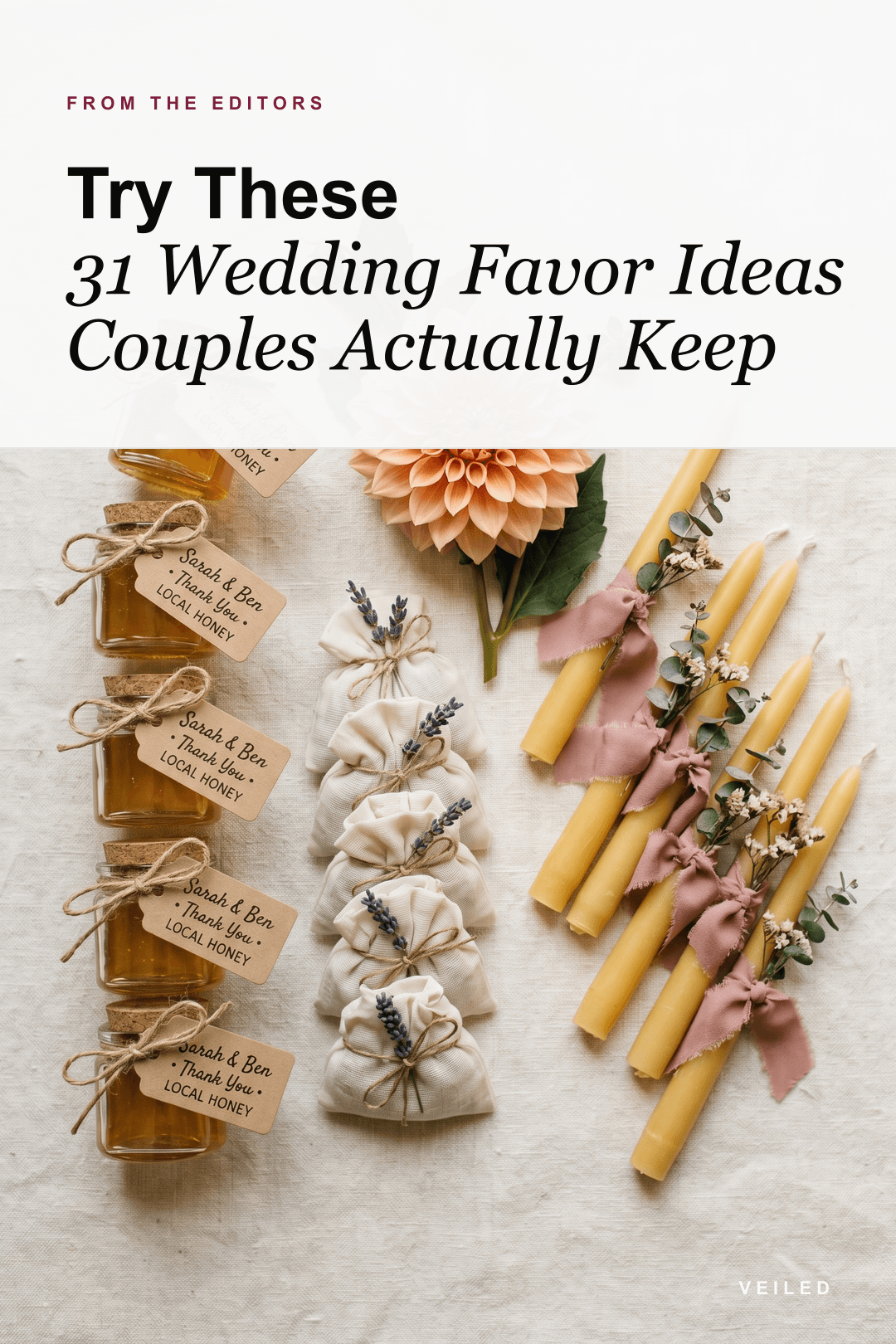
These are the categories that show up most often in our post-wedding follow-up surveys when we ask couples a year later what their guests still mention. The pattern: small, edible or consumable, beautifully wrapped without going overboard. The wedding favor ideas worth steal-grade attention all share these traits.
- Local honey or olive oil in 2 oz jars with handwritten kraft tags — small, edible, ages well, ~$3-$6/guest
- Lavender sachets in raw muslin or linen — used in drawers and gym bags for months, ~$2-$4/guest
- Dipped beeswax tapers tied in silk ribbon — beautiful at home, smell good, ~$5-$8/guest
- Custom recipe cards (one card with the couple's signature dish) — kept in kitchen tool drawers, $1-$2/guest
- Mini bottles of a couple's favorite hot sauce or spice blend — used within a month, ~$3-$5/guest
"If a favor wouldn't survive three days at the bottom of someone's bag, it doesn't get used. The bar is higher than couples assume."
Edible favors that get eaten (not just photographed)
Edible favors split into two camps. The first is the kind guests photograph but don't eat: precious-looking macarons in a glassine bag, hand-painted chocolates with the couple's monogram. These are pretty and get posted to Instagram but rarely make it home in eatable condition. The second is the kind that genuinely travels: shelf-stable jars, vacuum-sealed coffee beans, small bags of a regional spice mix. The second category outperforms the first 3-to-1 on actual consumption.
If you go edible, prioritize travel-stable. A 2 oz jar of local honey with a wax seal is roughly the same per-guest cost as the photogenic macarons, doesn't melt in a hot car, doesn't crumble in a clutch, and gets eaten within two weeks. Couples who prioritize the photogenic version often regret it after the wedding when they realize the favors had a 6-hour shelf life.
Locally-sourced favors that tell a story
The strongest wedding favor ideas in 2026 lean local. A jar of honey from a hive ten miles from the venue, a small bottle of olive oil from the family farm where the bride grew up, a packet of seeds from a flower farm in the venue's town. The favor becomes a small piece of place that guests can't get on Etsy.
The mechanic that works: identify one local maker (honey, jam, candle, soap, baked good) and source the entire favor batch from them. Most small producers will do custom labels for orders over 50 units at minimal markup. The favor reads as considered without the per-unit cost climbing into the absurd. Search 'local food artisan' or 'small-batch maker' near your venue and start with what shows up first; the volume of local producers in most U.S. markets is wildly underestimated.
DIY wedding favors that don't look DIY
If the budget is tight, DIY favors work in two specific lanes: dipping (candles, chocolate-dipped fruit) and small-batch jarring (jam, herb-infused salt, seasoning blends). Both produce results that read as artisan rather than as crafty.
What doesn't work for DIY: anything requiring a printer (custom labels look home-printed unless you spend on a real printer), anything with hot glue, anything with mason jars whose lids have been hand-painted. These all signal DIY in unflattering ways. Stick to lanes where the technique itself produces a polished outcome.
The case for skipping favors entirely
About 30 percent of couples we audited in 2024 and 2025 didn't do favors at all. None of them regretted it. The money saved (around $400-$800 at a 100-guest wedding) went into either a more elaborate dessert station, a coffee or espresso bar, or simply the bottom line. Guests don't measure how special a wedding is by whether they got a small bag at their place setting.
If you skip favors, the move that fills the visual gap at the place setting is a beautifully written menu card or a small handwritten note from the couple to each guest. Both feel more personal than the standard favor and cost roughly nothing if you do it yourselves the week before.
Per-guest budget tiers, honestly
Under $3/guest: skip the favor or do recipe cards / handwritten notes. Anything purchased in this tier reads as filler. Couples who try to make $1-$2 favors look elevated almost always regret it.
$3-$6/guest: local honey, lavender sachets, custom hot sauce. The sweet spot for thoughtful-without-extravagant. Most couples land here when they think honestly about the math.
$6-$12/guest: dipped tapers, small artisanal soaps, individually-bottled cocktail mixers. Reads as generous without crossing into 'why was this much spent on a favor' territory.
Over $12/guest: usually unnecessary. A $15 favor reads as a gift the couple bought themselves through the registry rather than something each guest will value at $15.
FAQ
Frequently asked
Are wedding favors actually expected by guests in 2026?
Not really. Etiquette has shifted away from expecting favors, and skipping them entirely no longer reads as cheap. Couples we've featured who skipped favors had no guest complaints; the dessert station or coffee bar most of them spent the money on instead got more positive comments than any favor would have.
What's the most-saved wedding favor idea on Pinterest right now?
Local honey in 2 oz jars with handwritten kraft tags, by a wide margin. The pattern works because it photographs cleanly, ages well in a guest's pantry, and tells a story about the venue's region. Lavender sachets and dipped beeswax tapers are the runners-up.
Can wedding favors be eco-friendly without looking like a craft project?
Yes, if you stick to consumables and avoid printed paper anything. Beeswax tapers, jarred honey, herb-infused salt blends, lavender sachets — all of these are inherently low-waste because they're either eaten or used up. Avoid the eco-trap of plantable seed paper favors; they look craft-fair-y and most guests never plant them.